
In the early 1980s, Ford wanted to reduce the cost of paying its suppliers. Its accounts payable department in North America employed more than 500 people, and management believed better computer systems could bring that number down by a fifth. Much of the work involved checking whether purchase orders, delivery records, and invoices agreed. Whenever they did not, somebody had to investigate. Ford could have bought technology to help its employees investigate faster. Instead, it changed the payment process so that supplier invoices were no longer needed in that workflow.
Michael Hammer described the case in his 1990 essay, “Reengineering Work: Don’t Automate, Obliterate”. His objection was to the habit of using new technology to preserve old procedures. “It is time to stop paving the cow paths,” he wrote. More than three decades later, the question is worth asking again as organisations decide where to use artificial intelligence: how much of the work being automated should have been reconsidered in the first place?
Artificial Intelligence (AI) can help employees cope with a badly run institution. That is a real achievement. It is also a convenient place for management to stop. An organisation can become better at handling the consequences of its failures without becoming any less prone to them. Successful adoption, on its own, tells us very little about whether management has improved.
A proposal to automate a weekly report usually begins with the hours spent preparing it. That is a reasonable concern, particularly for the employee collecting figures from several departments. But it leaves other questions unanswered. Who reads the report? What decision depends on it? Why must the same figures appear in a spreadsheet, an email and a presentation? A report may exist because a manager once needed information during a crisis. Years later, the crisis may be forgotten while the reporting continues. Making its production cheaper can remove the inconvenience that might otherwise have forced someone to question it.
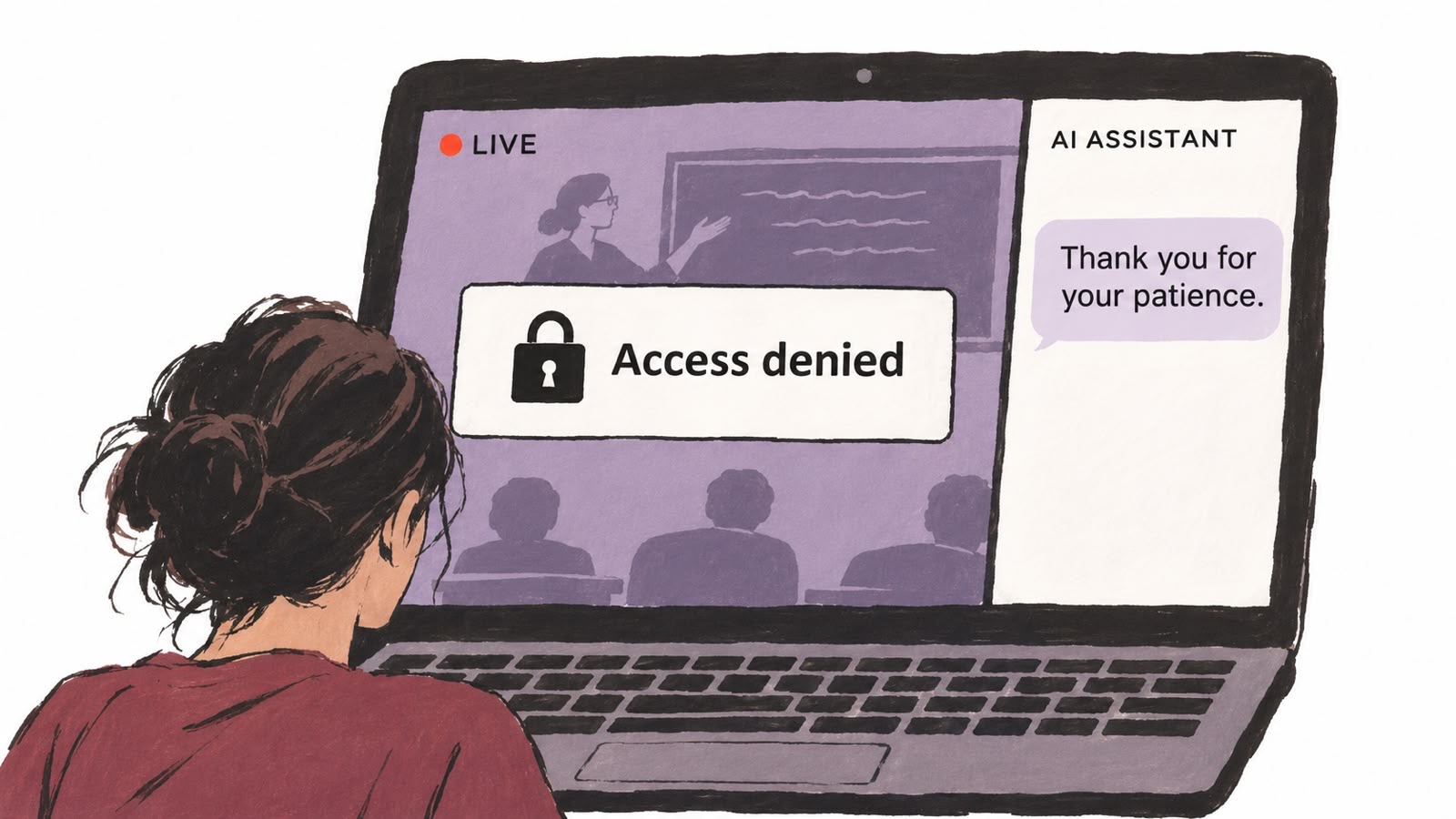
Working across education, AI, and operations has made me interested in the gap between completing a task and achieving its purpose. Consider a student who has paid for a course but cannot access the classes. Sales has recorded the admission, finance has confirmed the payment, and the operations team has issued a schedule. Each department can demonstrate that it has done its work. The student, meanwhile, is waiting. An AI assistant could retrieve the missing information and help resolve the case. It could also send a reassuring reply while leaving the student exactly where they were.
From the institution’s side, the second outcome can look deceptively good. The complaint has been acknowledged promptly. The response is courteous. There is a record of the exchange. A manager checking response times will see an improvement, although the student has gained nothing. The choice of what to measure has already decided which version of events reaches management.
The obvious advice is to fix the organisation before automating its work. But that advice is much easier to give than to live with.
The employee preparing the unnecessary report may have no authority to discontinue it. The admissions officer cannot merge the finance and sales databases. A new manager may understand the problem and still need months to negotiate a change. If AI gives these people an hour back today, why should they wait? Refusing useful assistance until management becomes competent would leave the cost of reform with the people already paying for its absence.
A bad process can still be made less exhausting. If an assistant helps an admissions officer find a missing record and get a student into class, that improvement counts. It does not become less valuable because the institution should have prevented the problem in the first place. Nor should the employee have to solve the entire admissions system to justify using something that makes a difficult day manageable.
There is evidence for such practical gains. In their 2025 studypublished in the Quarterly Journal of Economics, Erik Brynjolfsson, Danielle Li and Lindsey Raymond examined 5,172 customer-support agents and found that AI assistance increased issues resolved per hour by 15 per cent on average. Less experienced workers benefited disproportionately. The study concerns one company, not badly managed organisations as a category. But it gives us good reason to take the immediate benefits of assistance seriously.
The harder question is what happens after that relief. Once the report takes five minutes to prepare, does anyone still ask why it exists? Once a chatbot handles the complaints, does management still see the recurring failure behind them? When the inconvenience disappears from a manager’s day, the reason to act can disappear with it.
That is the risk I find more troubling than the familiar warning that AI can make mistakes. A tool can perform its assigned task well and still help an institution avoid a necessary change.
There is another possibility. The same assistant could reveal that most access complaints arise at one handover between departments. An admissions officer who has struggled to explain the pattern would then have evidence to put before management. AI would have made the failure harder to ignore. What happens next depends on whether anyone is prepared to change the arrangement that produces it.
The difference becomes apparent over time. Suppose staff use AI to work through a backlog while management repairs the handover. The temporary assistance has served a purpose. Suppose instead that the backlog is cleared, the repair is abandoned, and next month’s admissions produce the same complaints. Each round of automated recovery can be reported as another success. The employee and the student experience the recurrence; management sees the recovery figures.
This is also why task-level productivity deserves careful interpretation. In Denmark, Anders Humlum and Emilie Vestergaard linked surveys of chatbot adoption to administrative employment records. Workers reported time savings, but the researchers found no detectable average effect on earnings or recorded working hours over the period studied. The surveys and employment records were measuring different things. A task taking less time does not establish that the working week has shortened.
An unchanged working week does not make the assistance worthless either. Someone previously overwhelmed may finally be keeping up. The saved time might also be absorbed by additional assignments. These possibilities matter to employees, and the headline claim that AI saves time does not tell us which one they are experiencing. Management’s use of the gain is part of the outcome.
The same care is needed when AI helps management decide whether a problem has been resolved. Managers have long defended judgments by referring to scorecards, committees or consultants. AI did not invent this habit. It supplies another recommendation to defer to, often accompanied by a confident explanation. The danger in the admissions example is straightforward: a system’s assessment of the case becomes more authoritative than the student still asking for access.
The experiment involving 758 Boston Consulting Group consultants is relevant for this narrower reason. Fabrizio Dell’Acqua and colleagues found that AI improved performance on tasks within GPT-4’s capabilities. Yet on a separate managerial task deliberately selected to fall outside those capabilities, the combined AI groups were about 19 percentage points less likely to reach the correct answer. This was a finding about one task, not a verdict on AI-assisted decisions generally. It shows why success at drafting a response cannot be taken as evidence that the same system can reliably judge whether the underlying problem is solved.
In an admissions office, that distinction should be easy to test: can the student now enter the class? But if the institution accepts a closed ticket as sufficient evidence, it has chosen to stop looking before the outcome is known. Adding an employee’s approval does not correct this if the employee is also judged on how quickly tickets are closed. Responsibility remains with the people who decided what completion would mean.
This is where the argument returns to Ford. The question was whether the work itself needed to continue in its existing form. With AI, management can postpone that question while making life easier for staff. Sometimes the delay is justified. Changes take time, and essential services must continue. But a temporary arrangement needs an end beyond becoming cheaper to maintain. Otherwise, every improvement in coping becomes another reason to leave the cause alone.
I would not ask an employee to surrender a useful tool in the hope that the resulting inconvenience might force reform. Management should not need exhausted staff or angry customers to remind it of a problem it already knows about. The immediate benefit belongs in the case for AI. The recurring failure belongs in the assessment of management. Neither cancels the other.
The student waiting for access has no reason to care whether help comes from a redesigned process or an employee using AI to get around a broken one. If the student gets into class, something worthwhile has happened. But when the next student is stranded at the same point, management owes an explanation. Its answer cannot be, “We can now reply immediately.”
References
1. Hammer, Michael. “Reengineering Work: Don’t Automate, Obliterate.” Harvard Business Review 68, no. 4 (July–August 1990): 104–112. Original article
2. Brynjolfsson, Erik, Danielle Li, and Lindsey Raymond. “Generative AI at Work.” The Quarterly Journal of Economics 140, no. 2 (May 2025): 889–942. doi:10.1093/qje/qjae044.
3. Humlum, Anders, and Emilie Vestergaard. Still Waters, Rapid Currents: Early Labor Market Transformation under Generative AI. NBER Working Paper 33777, May 2025, revised March 2026. doi:10.3386/w33777. See also the authors’Brookings account, October 6, 2026.
- Dell’Acqua, Fabrizio, Edward McFowland III, Ethan Mollick, Hila Lifshitz, Katherine C. Kellogg, Saran Rajendran, Lisa Krayer, François Candelon, and Karim R. Lakhani. “Navigating the Jagged Technological Frontier: Field Experimental Evidence of the Effects of Artificial Intelligence on Knowledge Worker Productivity and Quality.” Organization Science, published online March 11, 2026.doi:10.1287/orsc.2025.21838.Full published text.
About the author

Dr. Roshan Babu
Dr. Roshan Babu is a medical graduate from AIIMS Raipur who transitioned into artificial intelligence, research, and business strategy. He currently works with AxiLearn, focusing on AI-driven education, product development, and strategic growth. His work spans interdisciplinary research, technology, organisational leadership, and educational innovation. He has a strong interest in geopolitics, public policy, history, and the intersection of technology and society.